How to Choose the Right TPU Fabric for Ultra-Lightweight Inflatable Products
The demand for ultra-lightweight inflatable products is growing rapidly in outdoor sports, water safety, travel, and emergency equipment markets.
Many product developers are looking for inflatable solutions that can achieve:
- Extremely compact folding size
- Lightweight transportation
- Easy storage
- Reliable durability in outdoor environments
However, choosing the right inflatable material is not always simple.
A thinner fabric can reduce weight and packing volume, but it may also create challenges in durability, welding performance, and long-term reliability.
The ideal TPU fabric is not always the thinnest option. It is the material that provides the best balance between:
Weight + Compactness + Durability + Manufacturing Feasibility
This guide explains how to select the right TPU fabric for lightweight inflatable product development.
Why TPU Fabric Is Widely Used for Lightweight Inflatable Products
TPU (Thermoplastic Polyurethane) laminated fabric has become a popular material choice for premium inflatable products.
Compared with traditional PVC materials, TPU offers several advantages:
Lightweight Performance
TPU fabrics can achieve excellent strength-to-weight ratios, making them suitable for products where portability is important.
Applications include:
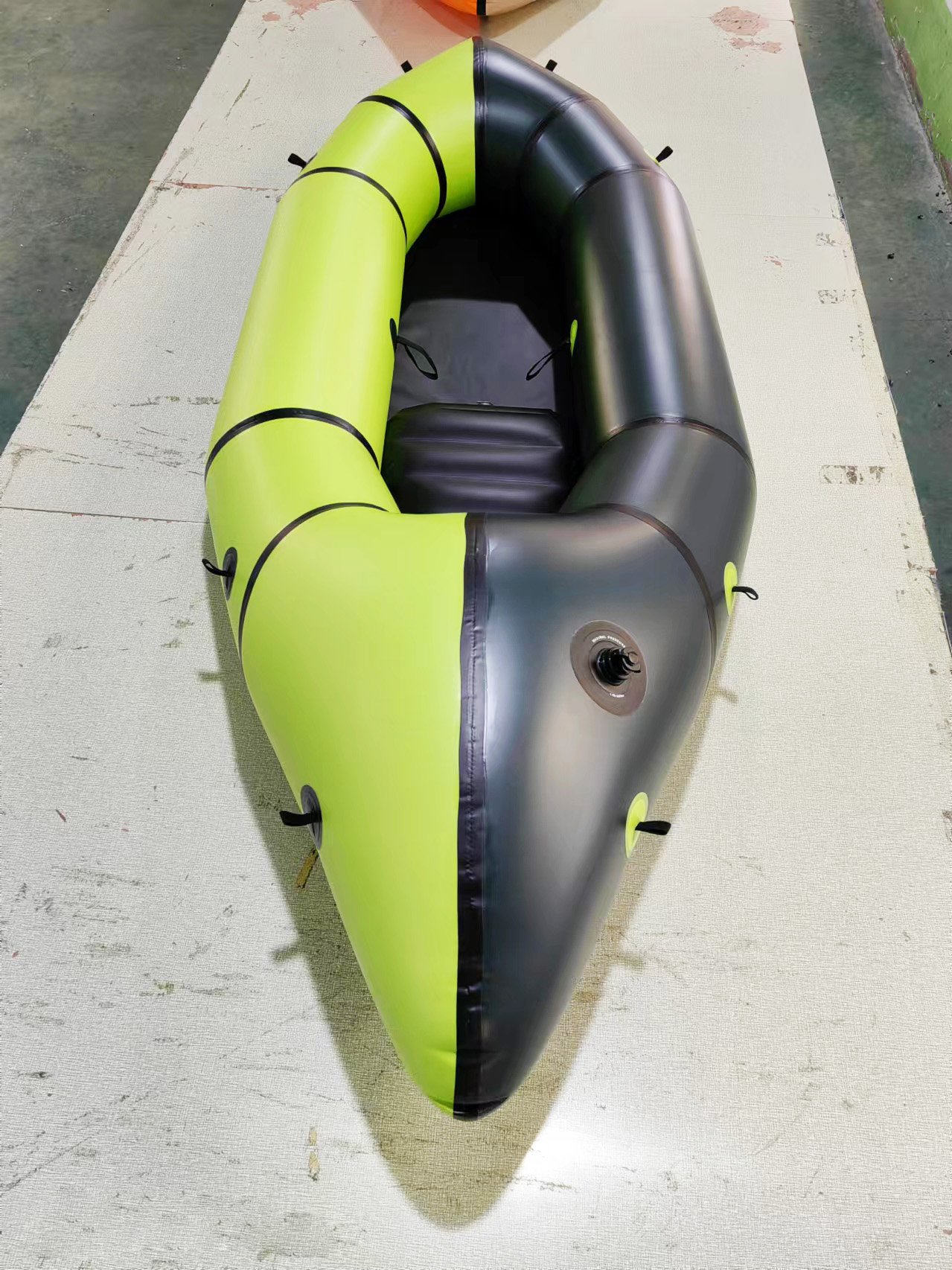
- Packrafts
- Inflatable emergency equipment
- Lightweight water sports products
- Outdoor adventure gear
Better Folding and Compact Storage
For products designed to be packed into small spaces, material flexibility is critical.
A suitable TPU fabric can help reduce:
- Folded volume
- Transportation cost
- Storage requirements
Strong Welding Performance
TPU materials can be processed through heat welding technology, creating strong and reliable seams without traditional adhesives.
This makes TPU suitable for inflatable products requiring:
- Air retention
- Waterproof performance
- Long-term reliability
Understanding TPU Fabric Structure
TPU inflatable fabrics are usually made from:
- Base fabric layer
- TPU coating layers
The base fabric provides mechanical strength, while the TPU coating provides:
- Air tightness
- Waterproof performance
- Welding capability
The coating thickness is an important factor during manufacturing.
Although reducing material thickness can help lower weight, the TPU coating must maintain sufficient thickness to achieve reliable heat welding performance.
Therefore, ultra-thin TPU materials require more careful processing control during production.
TPU Fabric Options for Ultra-Lightweight Inflatable Products
Different applications require different material solutions.
Below is a general comparison of common TPU fabric options.
| TPU Fabric | Main Characteristics | Suitable Applications |
|---|---|---|
| 20D TPU | Extremely lightweight and compact | Ultra-light prototypes, compact inflatable solutions |
| 30D TPU | Lightweight with improved strength | Lightweight outdoor products |
| 40D TPU | Balanced weight and durability | Outdoor inflatable equipment |
| 70D TPU | Higher durability while maintaining portability | Packrafts and reusable inflatable products |
| 210D TPU | Strong and reliable performance | Standard inflatable products |
| 420D TPU | Heavy-duty durability | Commercial and high-abrasion applications |
20D TPU: Maximum Lightweight Performance
20D TPU represents one of the lightest material options for inflatable product development.
Advantages:
- Extremely low weight
- Excellent portability
- Minimal folded size
Potential applications:
- Emergency inflatable equipment
- Single-use or limited-use products
- Ultra-light travel products
However, ultra-light materials require careful evaluation because thinner fabrics may have limitations in:
- Abrasion resistance
- Tear strength
- Manufacturing processing
For this reason, 20D TPU is usually considered for specialized lightweight applications rather than all inflatable products.
30D and 40D TPU: Finding the Balance
30D and 40D TPU materials provide a good balance between weight reduction and durability.
These materials are suitable when customers need:
- Compact packing size
- Lightweight transportation
- Better durability compared with ultra-thin materials
Potential applications:
- Lightweight packrafts
- Outdoor inflatable equipment
- Portable water products
For many product developers, 30D and 40D TPU can be an ideal middle solution.
70D TPU: A Popular Choice for Outdoor Products
70D TPU provides increased durability while keeping the product relatively lightweight.
Advantages:
- Better abrasion resistance
- Improved strength
- Suitable for repeated outdoor use
Common applications:
- Packrafts
- Inflatable kayaks
- Outdoor adventure products
For customers looking for a reusable inflatable product with a compact design, 70D TPU is often a practical choice.
210D and 420D TPU: Durable Production Solutions
210D and 420D TPU fabrics are commonly used for products requiring higher durability.
210D TPU
Advantages:
- Reliable strength
- Good balance between weight and durability
- Suitable for regular outdoor use
Applications:
- Inflatable boats
- Packrafts
- Water sports products
420D TPU
Advantages:
- Higher abrasion resistance
- Stronger mechanical performance
- Suitable for demanding environments
Applications:
- Commercial inflatable equipment
- Heavy-duty outdoor products
How to Choose the Right TPU Thickness for Your Product?
Choosing TPU fabric depends on several factors.
1. Product Usage
Ask:
Is the product:
- Single-use?
- Limited-use?
- Long-term reusable?
A lightweight emergency product may require a different material compared with a professional packraft.
2. Required Folding Size
If the product needs to fit into:
- Vacuum bags
- Backpack storage
- Travel luggage
a thinner TPU fabric may provide advantages.
3. Environmental Conditions
Consider:
- Freshwater or seawater use
- UV exposure
- Abrasion conditions
- Temperature changes
Ocean and outdoor environments usually require stronger material performance.
4. Manufacturing Requirements
Material selection also needs to consider production feasibility.
Ultra-thin TPU fabrics require:
- Accurate heat control
- Proper welding parameters
- Experienced manufacturing processes
A suitable material must not only work in theory but also be reliable during mass production.
How We Develop Lightweight TPU Inflatable Products
At Xsea-Tech, we support customers from material selection to final production.
Our development process includes:
Material Evaluation
We test different TPU fabric options based on:
- Weight requirements
- Durability requirements
- Product application
Prototype Development
We evaluate:
- Welding performance
- Air retention
- Folding performance
- Overall design
Production Optimization
Before mass production, we optimize:
- Material selection
- Welding parameters
- Manufacturing processes
This helps customers achieve the right balance between product performance and production cost.
Custom TPU Inflatable Product Development
Different markets require different inflatable solutions.
Xsea-Tech provides OEM and ODM development services for:
- Packrafts
- Inflatable water equipment
- Lightweight outdoor products
- Custom TPU inflatable products
We can support:
- Material recommendation
- Prototype manufacturing
- Custom design
- Production development
Choosing the right TPU fabric is the first step toward creating a successful lightweight inflatable product.
Frequently Asked Questions
What is the thinnest TPU fabric for inflatable products?
The suitable TPU thickness depends on the product application. Ultra-light TPU options such as 20D can reduce weight and packing size, but durability and manufacturing requirements must also be considered.
Is thinner TPU fabric always better?
No. The best material is the one that provides the right balance between weight, durability, welding performance, and product requirements.
Which TPU fabric is best for packrafts?
70D and 210D TPU are commonly used for reusable packrafts because they provide a good balance between portability and durability.
Can TPU inflatable products be vacuum packed?
Yes. With proper material selection and product design, TPU inflatable products can be compressed into compact packaging solutions.
Can manufacturers customize TPU inflatable products?
Yes. Professional OEM manufacturers can help customers select materials, develop prototypes, and produce customized inflatable products.
Learn More
Learn more about TPU Packraft manufacturing capabilities.

Related Solutions
Discover our full range of Inflatable Water Sports products.