Efoil Battery Guide (2026): Range, Charge Time, Safety & Replacement

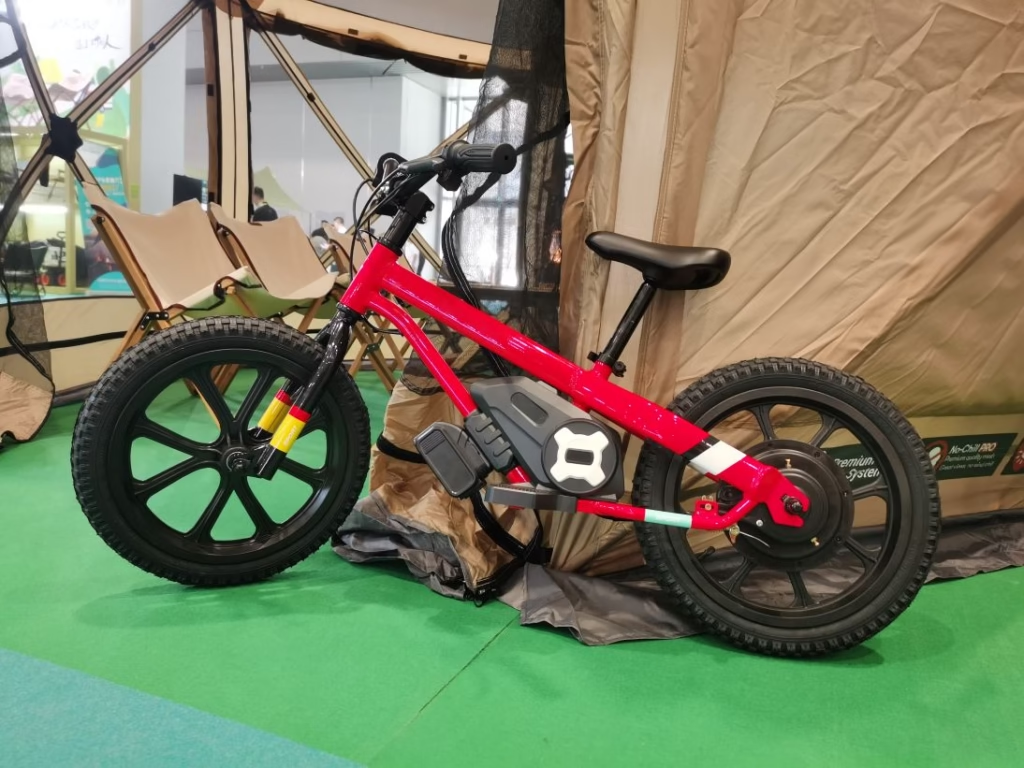
efoil battery pack inside an electric hydrofoil board

Efoil Battery Guide (2026): Range, Charge Time, Safety & Replacement

An efoil’s battery is the single most important — and most expensive — component on the board. It decides how long you fly, how fast you go, and how much the board costs to own over time. This guide breaks down efoil battery capacity, real-world ride time, charge time, lifespan, replacement cost, safety, and shipping rules, with a dedicated section for distributors and brand owners sourcing batteries at the OEM level.

Quick Answer

  • Capacity: Most modern efoil batteries range from 1.5 kWh to 2.5 kWh, operating at 40–60V high-voltage lithium-ion (Vaveo).

  • Real ride time: Expect 45 minutes to 2 hours on a full charge, typically 10–20% less than the manufacturer’s claimed figure (Vaveo; Waydoo Europe).

  • Charge time: 2–3 hours for a standard pack, 3–5 hours for extended-range packs (Medium).

  • Lifespan: Roughly 400–800 charge cycles depending on brand and cell quality (Vaveo).

  • Replacement cost: $1,200–$3,500, making the battery the most expensive consumable on an efoil (Vaveo).

  • Safety: Never charge to 100% for storage (use 60–70%), never charge a cold battery unattended, and keep a lithium-specific fire extinguisher nearby (Vaveo).

1. How an Efoil Battery Works

Every efoil runs on a lithium-ion battery pack built into — or attached to — the board. The pack powers a brushless electric motor and propeller mounted on the mast, lifting the rider above the water as speed builds.

Battery capacity is measured in kilowatt-hours (kWh) or watt-hours (Wh): more stored energy means longer ride time. Most efoil packs are high-voltage lithium-ion systems operating at 40–60V, chosen for high energy density, efficiency, and long lifespan . The pack also includes a Battery Management System (BMS) that balances cells, prevents overcharge and deep discharge, and monitors temperature — a critical safety and longevity component we cover in the B2B section below.

2. Efoil Battery Capacity & Real Ride Time by Brand

Here’s how the leading efoil batteries compare on capacity, claimed ride time, and what you can realistically expect on the water:

BrandModelBattery CapacityClaimed Ride TimeReal-World Ride Time
Lift FoilsLift52.5 kWh105 min85–95 min
Lift FoilsLift32.0 kWh80 min65–75 min
FliteboardS5 Series2.2 kWh90 min75–85 min
SiFlySiFly E1.8 kWh75 min60–70 min
WaydooFlyer ONE+1.5 kWh60 min45–55 min
WaydooEVO Pro2.0 kWh80 min65–75 min

Across the market, efoil batteries range from roughly 1,500 Wh to just over 2,500 Wh, and most deliver 60 to 90 minutes of riding under average conditions.

The golden rule: treat manufacturer ride-time figures as a ceiling, not a promise. Real-world sessions typically run 10–20% shorter than the claimed maximum .

3. What Affects Efoil Battery Range

The same battery can deliver very different ride times depending on how and where you ride. The biggest factors:

  • Rider weight. A 220 lb (100 kg) rider consumes roughly 30% more energy than a 150 lb (68 kg) rider at the same speed .

  • Speed. Cruising at a moderate 15 mph can roughly double your ride time compared to riding at full throttle .

  • Water conditions. Flat water is 15–20% more efficient than choppy water .

  • Temperature. Cold water and air below 50°F (10°C) can cut capacity by 10–20%. Lithium batteries perform best at 60–80°F (15–27°C) .

In practice, most riders find their legs give out before a healthy battery does during a 90-minute session.

4. How Long Does an Efoil Battery Take to Charge?

Battery TypeFull Charge Time
Standard efoil battery2–3 hours
Extended-range battery3–5 hours

By brand, charge times generally fall between 2 and 2.5 hours:

BrandModelCharge Time
Lift FoilsLift5 / Lift32.5 hrs
FliteboardS5 Series2.0 hrs
SiFlySiFly E2.0 hrs
WaydooFlyer ONE+2.5 hrs
WaydooEVO Pro2.0 hrs

Some premium systems offer fast-charging — for example, Lift Foils’ Full Range Gen4 battery reaches 80% in about 50 minutes, and the Light Gen4 in about 30 minutes .

Practical tip: if your board supports a swappable battery, a charged spare pack doubles your day on the water. Waydoo’s Flyer EVO platform is built around this modular, hot-swappable concept  — worth considering when comparing models.

5. Efoil Battery Lifespan & Cycle Count

A lithium-ion efoil battery is a wear item. It degrades gradually with every charge cycle.

BrandExpected Lifespan (Charge Cycles)
Lift Foils500–800 cycles
Fliteboard500–800 cycles
SiFly400–600 cycles
Waydoo400–600 cycles

At roughly 2–3 rides per week, a 500-cycle battery translates to about 3–4 years of use before noticeable capacity loss. Cell quality, BMS design, and charging habits all stretch or shorten that window — which is why the safety and care practices in the next section matter so much.

6. Efoil Battery Replacement Cost

The battery is the most expensive consumable component on an efoil. Here’s what to budget:

BrandReplacement CostExpected LifespanApprox. Cost per Ride Hour
Lift Foils$2,500–$3,500500–800 cycles~$4.50/hr
Fliteboard$2,000–$3,000500–800 cycles~$4.00/hr
SiFly$1,800–$2,500400–600 cycles~$4.50/hr
Waydoo$1,200–$1,800400–600 cycles~$3.50/hr

If you ride regularly, factor the cost per ride hour into your purchase decision — a cheaper board with a short-lived battery can cost more over 3 years than a premium board with a long-lasting pack.

7. Efoil Battery Safety: Charging, Storage & Fire Risk

Lithium-ion batteries are safe when handled correctly — and dangerous when they’re not. Follow these rules.

Storage Charge Level

  • Never store at 100%. Full-charge storage accelerates cell degradation.

  • If the battery won’t be used for a week or more, store it at 60–70% charge.

  • Never fully drain the battery — stop riding when the remote shows 15–20% remaining. Deep discharges stress cells and reduce longevity.

  • Charge a depleted battery back to 60–70% within 24 hours.

Charging Safety

  • Charge at room temperature. Never charge a cold battery — let it warm to at least 60°F (15°C) first.

  • Always use the manufacturer’s charger. Third-party chargers can deliver incorrect voltage or amperage, risking damage or fire.

  • Do not charge unattended overnight. Modern chargers have safety shutoffs, but being present is best practice.

  • Store in a cool, dry place — avoid direct sunlight, hot cars, and humid environments.

Physical Handling & Inspection

  • Never puncture or drop the battery. Physical damage can cause internal short circuits and thermal runaway.

  • Inspect before every session for cracks, swelling, corrosion, or loose connectors.

  • A swelling battery is a failing battery — stop using it immediately.

  • Rinse the board and battery compartment with fresh water after every ocean session; salt corrosion damages connectors and seals.

Fire Risk & Emergency

  • Lithium-ion batteries are safe when handled properly, but keep a Class D or lithium-specific fire extinguisher nearby — water does not work on lithium fires.

  • Stop using the battery immediately if it shows swelling, discoloration, unusual heat during charging, or a chemical smell. Contact the manufacturer for safe disposal guidance.

Regulatory note: In the United States, the Coast Guard classifies efoils as vessels, which means riders must carry a fire extinguisher unless everyone aboard is wearing a USCG-approved PFD — along with vessel registration and other safety equipment.

8. Traveling & Shipping with Efoil Batteries

Efoil batteries are large lithium-ion packs, which means strict transport rules.

  • Air travel: Passenger airline limits for spare lithium-ion batteries are commonly 100 Wh, with limited exceptions up to 160 Wh only with airline approval. Efoil batteries are 1,500–2,500 Wh — far above those limits — so they are prohibited on all commercial flights, in both carry-on and checked luggage .

  • Road travel: Transport the battery upright, in a cool, ventilated area, in its original case or a battery bag. Never leave it baking in a hot car.

  • Ferries and boats: Most ferries allow lithium batteries but may require them to be disconnected and stored separately — check with the operator.

  • International shipping: Use ground freight or specialized freight services. FedEx and UPS run dedicated lithium-battery programs, but international hazmat rules vary by country .

What Is UN38.3, and Why Does It Matter?

Before a large lithium battery can be shipped by air, sea, or road, it must pass UN38.3 testing — a series of eight design tests (altitude simulation, thermal, vibration, shock, external short circuit, impact, overcharge, and forced discharge) set out in the UN Manual of Tests and Criteria, Part III, Subsection 38.3 (TÜV SÜD; PHMSA).

Under U.S. and international dangerous-goods rules, manufacturers and distributors must make a UN38.3 test summary available to anyone in the supply chain, and the requirement applies across all transport modes (PHMSA; IATA). The pack is then classified as Class 9 (miscellaneous) dangerous goods, most commonly as UN3480 (lithium-ion batteries shipped standalone) or UN3481 (lithium-ion batteries packed with or contained in equipment) (PHMSA Lithium Battery Guide). For standalone shipments by air, the battery must also be shipped at a state of charge not exceeding 30% of rated capacity (IATA).

For B2B buyers importing efoils, UN38.3 compliance isn’t optional — without a valid test summary, freight forwarders and carriers can refuse the cargo and customs can hold the shipment.

Battery Capacity vs Motor Power: Does an 8KW Efoil Drain Faster?

A common worry is that a high-power motor — like the 8KW system on our Carbon Fiber Efoil— must drain the battery faster. In reality, motor peak power is not constant power draw.

The actual energy consumed on any given ride depends on:

  • Throttle position — most riding happens well below the 8KW ceiling.

  • Cruising speed — moderate speeds use a fraction of full-throttle energy.

  • Rider weight — a heavier rider draws more current to get on foil.

  • Foil and board efficiency — a well-matched wing and a stable, buoyant board (like an inflatable hull) get on foil earlier and stay up with less power.

In practice, once the board is flying, it takes relatively little continuous power to maintain flight — the big energy draw is the takeoff phase. So an 8KW motor gives you strong, reliable lift without forcing you to ride at full throttle, which is what actually protects your range. Battery capacity (kWh) and your riding habits move the range needle far more than the motor’s peak wattage rating.

How to Extend Your Efoil Battery Life

A few habits will add hundreds of charge cycles to your pack’s lifespan:

  1. Store at 60–70%, never at 100% or near 0%.

  2. Avoid deep discharges — stop riding at 15–20% remaining.

  3. Charge at room temperature; never charge a cold or hot battery.

  4. Use the original charger with built-in BMS communication.

  5. Rinse after every saltwater session to protect connectors and seals.

  6. Inspect for swelling or damage before every ride.

  7. Cruise, don’t pin the throttle — moderate speed roughly doubles ride time per charge.

10. For B2B Buyers: Battery Specs That Matter for OEM & Wholesale

If you’re a brand owner, distributor, or importer sourcing efoils at the OEM level, the battery is where you win or lose on safety, certification, and margin. Look for:

  • Cell grade & origin: Name-brand 18650/21700 cells (e.g. Samsung, LG, Panasonic, EVE) with documented cycle-life data.

  • BMS quality: A robust BMS with cell balancing, over-charge/discharge protection, temperature sensing, and dual-band telemetry — not just a basic cutoff board.

  • UN38.3 test summary: Required for international shipping. Confirm the pack has passed all eight UN38.3 tests and carries a valid test report.

  • Certifications: CE, RoHS, and — for the European market — compliance with the EU Battery Regulation (EU 2023/1542) and battery passport requirements.

  • Thermal management: Verify whether the pack uses passive air cooling or active liquid cooling, and request cycle-life data under sustained load.

  • IP rating & seal replacement schedule: IP67 or IP68 waterproofing, with a documented maintenance schedule for seals and connectors.

  • Warranty & serviceability: Minimum 1-year warranty on electronics, with clear repair logistics and spare-battery availability.

These are the same checkpoints to use when evaluating an efoil OEM supplier. For a full walkthrough of how an efoil goes from prototype to mass production — including battery, motor, ESC, and full quality testing — see our Efoil OEM Manufacturing guide.

Frequently Asked Questions

How long does an efoil battery last per charge?

Between 45 minutes and 2 hours depending on battery capacity, rider weight, speed, and conditions. Real-world ride times are typically 10–20% below the manufacturer’s claimed figure .

How long does an efoil battery take to charge?

2–3 hours for a standard pack and 3–5 hours for extended-range packs .

How long does an efoil battery last before replacement?

Roughly 400–800 charge cycles, or about 3–4 years of regular use, depending on brand and cell quality.

How much does a replacement efoil battery cost?

Between $1,200 and $3,500, depending on the brand and capacity. It’s the most expensive consumable on the board .

Can I take an efoil battery on a plane?

No. Efoil batteries are 1,500–2,500 Wh, far above the 100 Wh airline limit, and are prohibited on all commercial flights. Ship by ground freight instead .

Can I charge my efoil battery overnight?

It’s not recommended. Even with safety shutoffs, charging unattended overnight is a fire risk. Charge during the day while you’re present, at room temperature, with the manufacturer’s charger .

Is it safe to leave my efoil battery in a hot car?

No. Lithium batteries degrade and become dangerous when exposed to high heat. Store in a cool, dry place, ideally at 60–70% charge if you won’t be riding soon .

Work With Us — Efoil Battery & OEM Solutions

At Xsea, we help brands, distributors, and rental operators specify the right efoil battery capacity, BMS protection, waterproofing, UN38.3 shipping documentation, and certification requirements for OEM efoil projects.

Ready to start your efoil project? Contact us today for OEM, wholesale, and custom battery solutions.

Related Products

Learn more about our complete manufacturing solutions.

Explore our complete product portfolio.

Scroll to Top