How to Choose an Inflatable Gangway for a Yacht or Boat
Choosing the right inflatable gangway is important for safe, comfortable boarding between a yacht, boat, dock or floating platform. A suitable gangway should match the boarding distance, height difference, vessel type, expected load and water conditions.
Unlike a rigid aluminum, carbon-fiber or wooden gangway, an inflatable gangway uses a high-pressure drop-stitch structure. When inflated correctly, it creates a firm and portable boarding surface that can be packed into a carry bag when not in use. Inflatable models are commonly valued for their lightweight storage, non-slip deck options and flexible use around boats, yachts, docks and waterfront areas.
What Is an Inflatable Gangway?
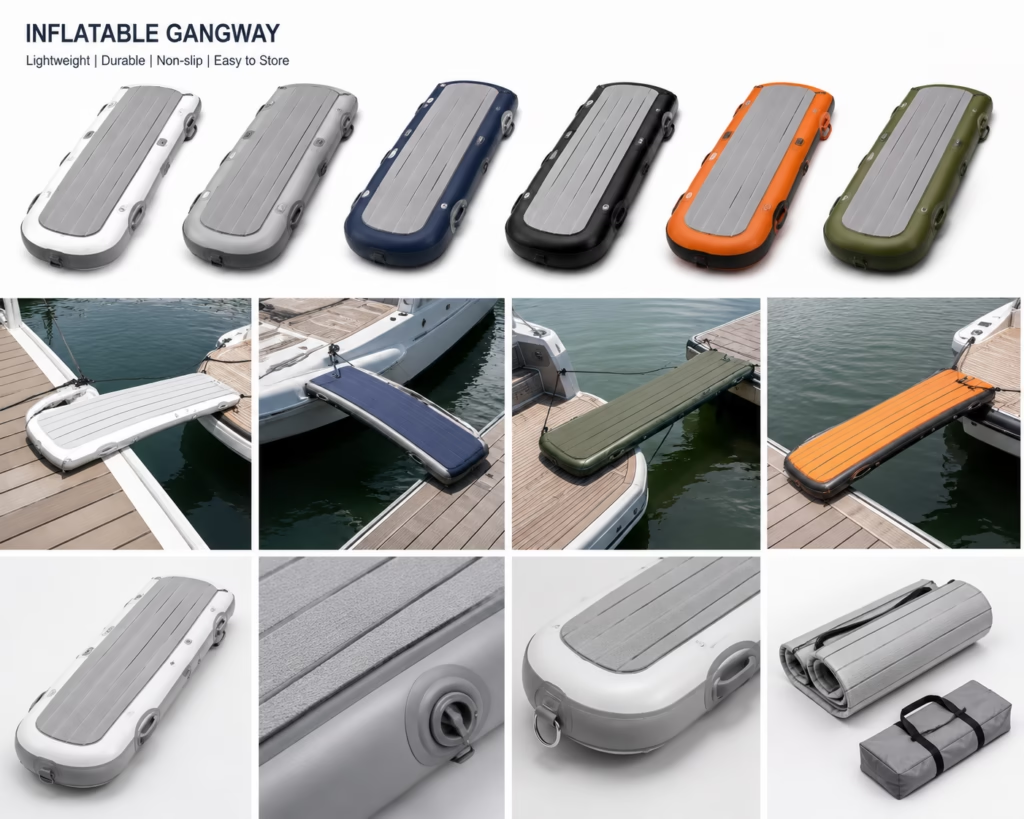
An inflatable gangway is a portable boarding ramp designed to create a safer walking route between a vessel and a dock, pier, floating platform or shore access point. It is commonly made with a high-pressure drop-stitch core, reinforced PVC material and a non-slip surface.
Depending on the design, an inflatable gangway may be used for:
Boarding and disembarking from boats and yachts
Access between a yacht and a floating dock
Temporary access at marinas and waterfront venues
Crossing a small gap between a boat and dock
Water access around swim platforms and leisure areas
Support access for cleaning, loading light items or preparing water-sports equipment
A proper gangway is not simply an inflatable mat. It should have adequate width, stiffness, grip, anchoring points and a connection method suitable for boarding use.
Start With the Boarding Situation
Before choosing a gangway size, first identify exactly where and how it will be used.
Ask these questions:
Will it connect a boat or yacht to a fixed dock, floating dock or shore?
What is the usual horizontal gap between the vessel and the dock?
How much does the gap change with tides, wake, loading and water level?
What is the height difference between the boat deck and the dock?
Will the gangway be used mainly in calm marinas, lakes, rivers or coastal waters?
Will it be used by private owners, guests, charter customers, crew or rental users?
Will people carry bags, supplies or water-sports equipment while walking on it?
Does the application require frequent setup and pack-away, or seasonal installation?
The best gangway is not necessarily the longest or widest option. It is the model that provides a stable walking angle and enough usable deck width for the actual boarding route.
Choose the Right Length
Length is usually the first specification buyers consider. However, gangway length should not be based only on the visible distance between a boat and the dock.
You should account for:
The normal horizontal boarding gap
The expected change in water level
The vertical difference between boarding points
The gangway angle during tide or vessel movement
The required overlap or secure connection area at both ends
A reasonable safety margin
A gangway that is too short may create a steep angle, reduce stability and make boarding uncomfortable. A gangway that is too long may be harder to store, handle and secure.
Basic Measurement Method
Measure the horizontal distance between the boat and dock at normal boarding position. Then measure the vertical height difference between the two boarding points.
For a more accurate estimated gangway length, use:
Then add extra length for safe overlap, attachment and water-level movement.
For example, if the horizontal gap is 1.8 m and the vertical difference is 0.6 m:
In practice, you would not select a 1.9 m gangway exactly. You should allow additional length for connection points, vessel movement and a more comfortable boarding angle. The final choice depends on your installation method, water conditions and product design.
Practical Length Guide
| Gangway Length | Typical Use | Things to Check |
|---|---|---|
| 1.8–2.0 m | Small boats, compact docks, short boarding gaps | Best for calm water and limited space; confirm the angle is not too steep |
| 2.0–2.5 m | Boats, yachts, floating docks and marina use | A versatile range for many standard boarding situations |
| 2.5–3.0 m | Larger vessels, variable dock gaps or higher boarding points | Requires suitable anchoring, deck space and storage planning |
| Custom length | Yacht projects, marina applications and branded OEM programs | Consider vessel geometry, expected tide range and user load |
Always measure at the highest and lowest expected water levels, not only during one calm, ideal docking situation.
Select a Suitable Width
Width affects walking comfort, perceived safety and whether users can board while carrying equipment.
A narrow gangway may save storage space, but it can feel unstable for guests, children, older users or people carrying bags. A wider gangway usually provides a more confident walking experience, especially in commercial, resort and charter applications.
When choosing width, consider:
Who will use the gangway
Whether users will carry bags or equipment
Whether shoes, bare feet or wet feet are expected
Whether the gangway will be used by one person at a time
Available deck and dock space
The intended market and product positioning
For private leisure use, a compact width may be sufficient. For resorts, charter yachts, marinas and rental operations, a wider non-slip walking surface is usually more appropriate.
Do not describe a gangway as “safe for all users” simply because it is wider. Safe use also depends on correct anchoring, water conditions, maximum load, supervision and local operating requirements.
Check Thickness and Drop-Stitch Construction
The core structure is one of the most important factors in an inflatable gangway. A high-pressure drop-stitch core contains thousands of internal threads that connect the upper and lower layers, helping the product maintain a flatter and more rigid shape when inflated.
For boarding applications, the gangway should provide:
A firm walking surface at the recommended pressure
Limited flex under expected load
A stable and consistent deck profile
Durable edge construction
Strong seams and reinforced connection points
Sufficient thickness for the intended span and user load
When comparing products, do not only ask whether the gangway uses “drop-stitch.” Ask for actual, product-specific information:
Recommended inflation pressure
Product thickness
Maximum stated load capacity
Net weight
Construction details
PVC material specification
Deck surface material
D-ring and handle reinforcement
Test method or quality-control process
A thicker product is not automatically better. The right thickness depends on length, width, pressure, internal construction, intended load and the gap it needs to bridge.
Prioritize a Non-Slip Deck
A gangway is often used with wet feet, wet shoes, spray, rain or water from swimming activities. The deck surface should therefore be selected for grip rather than appearance alone.
Common deck options include:
Textured PVC
EVA non-slip deck pad
Brushed EVA surface
Custom EVA color and pattern
Raised or embossed anti-slip areas
When selecting a deck, check:
Whether the non-slip surface covers the main walking route
Whether it remains comfortable for bare feet
Whether it is easy to clean after marine use
Whether the adhesive and material are suitable for the intended environment
Whether the color will become excessively hot in strong sunlight
Whether branding or logo printing affects the grip area
For OEM projects, the EVA deck pattern is also an important branding opportunity. You can use custom colors, logo placement, stripes or geometric patterns, but avoid placing large smooth logos in the main walking zone if they reduce traction.
Confirm Anchoring and Connection Design
A gangway should be secured at both ends according to its intended installation. The exact method depends on the vessel, dock, water movement, product design and local safety requirements.
Check whether the product includes or supports:
Reinforced stainless-steel D-rings
Mooring ropes
Connection straps
Dock attachment points
Boat-side attachment points
Handles for positioning
Optional safety line or handrail system
Anchor points for floating configurations
Protective pads at contact points
A gangway must not be treated as a loose floating mat. Before use, confirm that it is correctly positioned, secured and supported for the intended load.
For a yacht application, think about both ends separately:
| Connection Area | What to Check |
|---|---|
| Boat or yacht side | Deck edge, attachment point, boarding height, movement of vessel, protection against rubbing |
| Dock or pier side | Dock level, cleat or secure point, dock movement, surface condition, clearance |
| Floating dock side | Relative movement between the boat and dock, connection straps, anchor arrangement, walking angle |
| Shore or beach side | Ground stability, tide range, debris, sharp objects and changing water level |
Consider Water Conditions
Inflatable gangways are generally best suited to controlled or relatively calm boarding conditions. The product choice should reflect the operating environment.
Consider:
Lake, marina, river, harbor or open-coast use
Wind exposure
Boat wake and passing traffic
Waves and swell
Tide range
Current
Dock movement
Seasonal weather
Frequency of use
For calm lake, marina or protected yacht use, a portable inflatable gangway can be a practical solution. In exposed marine conditions, large wave movement, strong current or substantial height changes, a different boarding solution or additional engineered restraint system may be required.
Do not rely on the gangway alone to solve difficult boarding conditions. Safe access depends on the complete setup: the vessel, dock, fixing points, water movement, user behavior and operating procedures.
Match the Gangway to User Load
Ask how the gangway will really be used.
A private boat owner using it occasionally with one person at a time has different requirements from:
A charter yacht carrying guests
A resort with frequent visitor traffic
A marina with daily boarding activity
A rental business
A commercial water-sports center
A yacht service or maintenance crew
For each project, determine:
Maximum number of users allowed at one time
Whether users will carry bags, supplies or equipment
Whether children or older users may use it
Whether staff supervision is available
Whether the platform will be used daily or occasionally
Whether a replacement/repair plan is needed
Always follow the product’s stated maximum load capacity and intended-use instructions. Avoid promising commercial suitability unless the actual product configuration, testing, anchoring and operating plan support that claim.
Evaluate Portability and Storage
One of the key advantages of an inflatable gangway is that it can be deflated and stored when not in use. This is useful for yachts, boats and seasonal waterfront businesses with limited onboard space.
Before selecting a model, check:
Deflated packing dimensions
Total packed weight
Carry bag quality
Pump type and inflation time
Whether one or two people are needed for setup
Storage location on the yacht or boat
Drying and cleaning process before packing
Repair-kit availability
Spare parts and replacement accessory options
Inflatable gangways are commonly chosen because they are more portable and less bulky than many rigid gangways, particularly when storage space is limited.
Choose Accessories for Your Application
The right accessory package can make a standard gangway more useful for a specific buyer group.
Common Accessories
Hand pump or electric pump
Carry bag
Repair kit
Mooring rope
Connection straps
Reinforced D-rings
Carry handles
EVA non-slip deck pad
Boarding ladder
Anchor kit
Safety line or handrail solution
Custom logo printing
Private-label packaging
For Yacht and Boat Brands
Consider adding:
Custom EVA deck pattern
Brand logo printing
Premium carry bag
Custom product manual
Barcode and carton artwork
Color matching with boat accessories
Optional connection straps or dock attachment hardware
For Resorts and Rental Businesses
Consider adding:
Higher-visibility colors
More durable deck surface
Clear user instructions
Safety labels
Replacement repair kit
Spare pump option
Anchoring package
Tracking or asset-label system
Inflatable Gangway vs Rigid Gangway
Both inflatable and rigid gangways can be useful. The best option depends on the intended application.
| Feature | Inflatable Gangway | Rigid Gangway |
|---|---|---|
| Storage | Deflates and packs into a bag | Requires fixed storage space |
| Weight | Often easier to carry and move | Can be heavier depending on material |
| Portability | Suitable for seasonal or portable use | Better for permanent or dedicated installation |
| Deck feel | Firm when inflated correctly, with some natural flex | Usually more rigid underfoot |
| Setup | Requires inflation and securing | Usually ready after placement or installation |
| Custom branding | EVA pattern, PVC color, logo and packaging options | Material, color and logo options depend on construction |
| Best fit | Boats, yachts, floating docks, marinas and portable boarding needs | Permanent boarding routes and applications requiring engineered rigid access |
The selection should be based on the full use case, not only product price. If you need a permanently installed access route, frequent heavy loading or use in demanding water conditions, evaluate the complete boarding system carefully.
Questions to Ask Your Supplier
Before placing an order, ask for clear answers to these questions:
What are the exact inflated dimensions?
What is the recommended inflation pressure?
What is the stated maximum load capacity?
What is the product weight and packed size?
What material is used for the outer layer and deck surface?
Does it use a high-pressure drop-stitch core?
Is EVA decking included, optional or unavailable?
How are D-rings, handles and connection points reinforced?
What accessories are included?
What is the recommended anchoring or attachment method?
Is logo printing available?
Can the length, width, thickness or color be customized?
What is the MOQ for OEM orders?
What is the sample lead time and mass-production lead time?
Can you provide product instructions, packing details and quality-control information?
What after-sales support, repair kit and spare parts are available?
A professional supplier should be able to explain the product’s actual construction and limitations, rather than only promising “high quality” or “heavy duty.”
OEM Options for Inflatable Gangways
For marine accessory brands, distributors, yacht-equipment suppliers, resorts and project buyers, inflatable gangways can be developed as an OEM or private-label product line.
Typical customization options include:
Custom length, width and thickness
Custom PVC color combination
Custom EVA deck layout and color
Logo printing
D-ring and handle location
Boarding ladder or connection strap options
Mooring and anchor accessories
Custom carry bag
Private-label product manual
Retail packaging, barcode and carton marks
For OEM development, provide your supplier with the target application, vessel type, expected load, water environment, preferred size, color requirements, branding artwork and estimated order quantity. This helps the factory recommend a more suitable configuration.
Final Checklist
Before choosing an inflatable gangway, confirm that it matches your actual boarding requirements:
Measure the boarding gap and vertical height difference
Allow for tide, wake, water-level changes and vessel movement
Select suitable length and width for users and equipment
Confirm product thickness, pressure and stated load capacity
Choose a reliable non-slip deck surface
Check D-rings, handles, straps and connection design
Plan safe anchoring at both ends
Consider calm versus exposed water conditions
Confirm packed size, weight, pump and storage needs
Select accessories based on private, yacht, resort or rental use
Verify realistic OEM customization, MOQ and lead time
Follow all product instructions and local safety requirements
Need a Custom Inflatable Gangway?
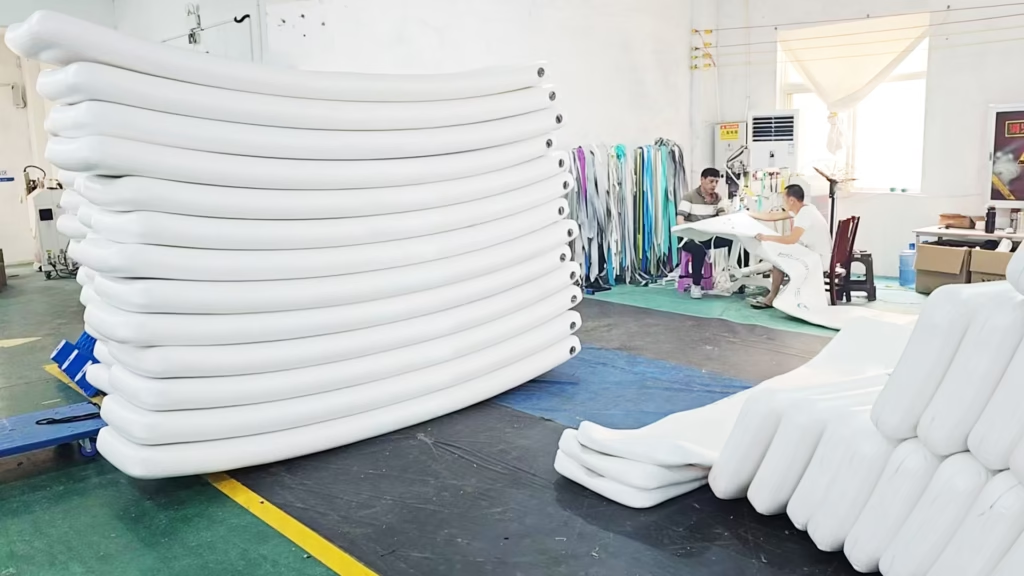
XSEA provides inflatable gangway solutions for boats, yachts, docks, marinas, resorts and water-sports businesses. We support OEM and private-label customization for size, thickness, color, logo printing, EVA decking, connection points, accessories and packaging.
Explore our [Inflatable Gangway product page] for standard configurations, or contact us with your vessel type, boarding distance, target market and estimated order quantity for a tailored proposal.